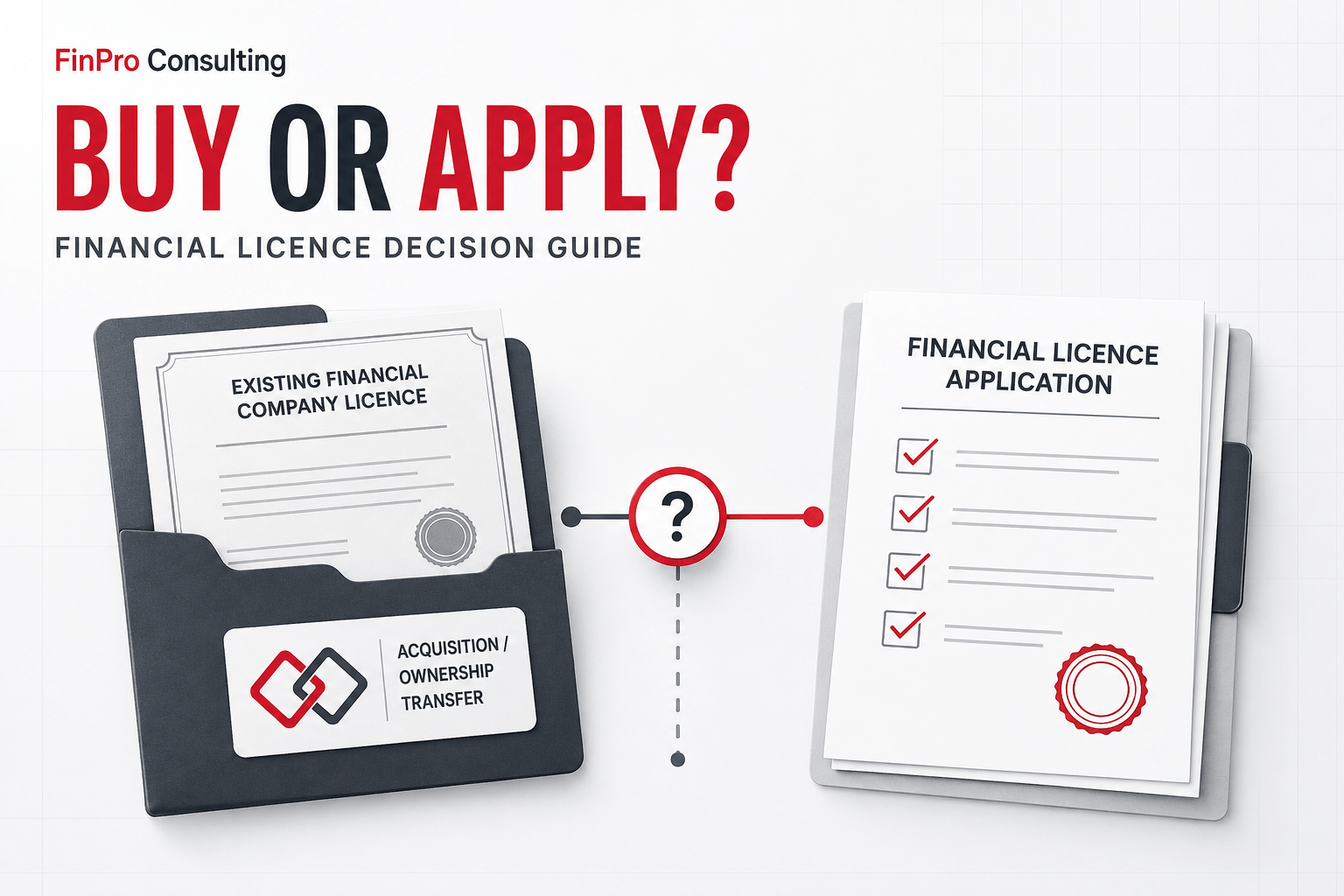
Should You Buy an Existing Financial Licence or Apply for a New One?
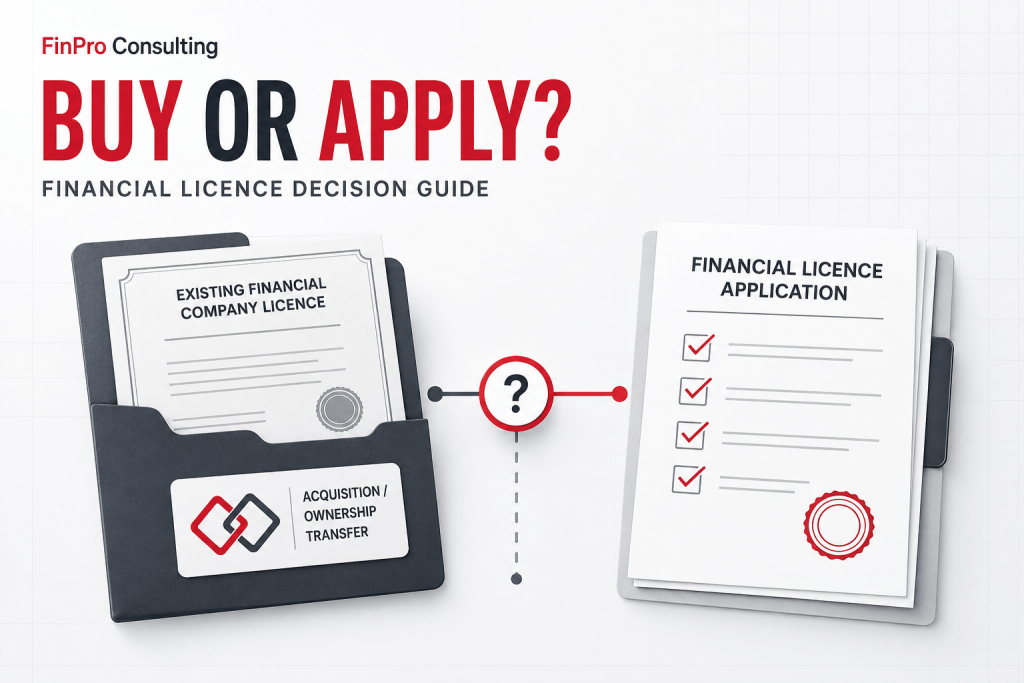
For a broker, investment firm or fintech business under pressure to launch, an existing licensed company can look like the shortest route to market. The company already exists, the licence has been issued and there may be an office, approved personnel, bank accounts and operating policies in place. By comparison, a new application can involve months of preparation, recruitment, capital planning and regulatory questions before approval is even considered.
That comparison is attractive, but incomplete.
In most transactions, the buyer is not purchasing a licence that can be detached from one company and attached to another. The buyer is acquiring shares or control of the legal entity that holds the licence. The entity keeps its regulatory history, contracts, records and liabilities, while the proposed new owners and managers may still have to pass regulatory review.
Key point: A financial licence normally belongs to the licensed legal entity. It is not a freely transferable certificate, and a change of ownership or control may require prior approval or notification.
Buying an existing regulated company can be the right decision. It can also be slower, more expensive and more difficult than starting afresh if the target has weak records, departing key personnel or banking relationships that do not survive the transaction. The decision should therefore be based on verified facts — not on the headline asking price or the phrase “ready made licence”.
What does “buying a financial licence” actually mean?
Market listings often advertise a “licence for sale”. Legally and operationally, the transaction is usually a sale of the licensed company.
In a share acquisition, the buyer purchases some or all of the shares in the licence holder. The company remains the same legal person, so its licence remains with that entity unless the regulator suspends, varies, revokes or otherwise restricts it. However, changes to shareholders, ultimate beneficial owners, controllers, directors or senior managers may trigger regulatory applications, notifications and fit and proper reviews.
In an asset acquisition, the buyer purchases selected assets such as a brand, domain, software, customer book or intellectual property. The licence generally does not follow those assets to the buyer’s company. If the acquiring entity intends to conduct the regulated activity itself, it will normally need its own authorisation or another legally valid arrangement.
This distinction matters when assessing a sale memorandum. A recognised company name, attractive domain or MT5 setup may have commercial value, but none of them proves that the buyer can operate the proposed regulated business after completion.
Why buyers consider an existing licensed company
A potentially shorter route to market
If the licence is active, the target is compliant, the proposed controllers are acceptable and the operating model remains substantially unchanged, acquisition may be quicker than building a new application. “May” is the important word. There is no reliable basis for promising that a purchase will always be faster.
The timetable depends on the regulator’s process, the completeness of the buyer’s file, any remediation required and whether new personnel, premises or systems must be approved. A signed share purchase agreement does not override these dependencies.
An established regulatory record
A well run firm may have several years of audited accounts, regulatory returns, compliance monitoring reports and correspondence with its regulator. That record can show that the company has operated within its permissions and maintained required capital and governance.
History, however, cuts both ways. The same entity may carry late filings, unresolved findings, customer complaints or weak anti money laundering controls. The longer the history, the more material there is to examine.
Existing infrastructure
A target may have an office, staff, compliance officer, money laundering reporting officer, responsible officers or other approved persons, along with policies, customer agreements, technology, banking and liquidity provider relationships.
These items should be treated as separate workstreams. Employees can resign. A landlord may not consent to assignment. A bank can reopen KYC. A technology provider may review the new owner and business model. The purchase price should not assume continuity unless it has been independently confirmed and documented.
The hidden risks behind a “ready made licence”
The company keeps its regulatory history
Changing shareholders does not erase the legal entity’s past. A buyer may inherit the consequences of delayed returns, deficient client money controls, capital shortfalls, complaints, regulatory investigations or remediation plans. Some issues may not appear on a public register.
Due diligence should therefore cover the complete regulatory file: licence conditions, inspection reports, information requests, breach notifications, compliance reports and evidence that required remediation was completed. A seller’s statement that the company is “clean” is not a substitute for records.
Client and contractual liabilities
For a broker or investment firm, historic client exposure can be significant. Buyers should establish whether the company has ever held client assets or money; whether balances remain outstanding; and whether there are unresolved withdrawals, refunds, chargebacks, negative balance disputes, complaints, litigation or arbitration.
The review should also include introducers, affiliates, liquidity providers, software vendors and outsourced service providers. Change of control clauses can allow a counterparty to terminate or renegotiate a contract precisely when the buyer expects to rely on it.
Tax and accounting exposure
Audited accounts alone may not reveal every risk. Review tax returns, payroll, value added tax where relevant, management accounts, bank statements, shareholder loans, related party transactions, contingent liabilities and off balance sheet commitments. Reconcile regulatory capital calculations to the underlying books and confirm whether the net asset value included in the price is real, available and unencumbered.
Legacy AML/KYC risk
If the target has onboarded customers, sample testing of customer files is essential. The review should examine risk classifications, beneficial ownership evidence, politically exposed person controls, sanctions screening, source of funds and source of wealth records, ongoing monitoring and suspicious transaction reporting procedures.
Poor historic KYC is not fixed merely by acquiring the company. Remediation can require a large scale customer refresh, account restrictions, additional staffing and difficult conversations with the regulator or banking partners.
Regulatory approval is not a closing formality
The exact rules differ by jurisdiction and licence category, but regulators commonly examine proposed direct and indirect owners, ultimate beneficial owners, controllers, directors and senior management. They may assess reputation, competence, financial soundness, regulatory history, source of wealth and the source of acquisition funds.
For example, Hong Kong’s Securities and Futures Commission generally requires a person to obtain approval before becoming a substantial shareholder of a licensed corporation. A person who becomes a substantial shareholder without prior approval because they were unaware of the change must apply to continue as one within the applicable statutory timeframe.. Cyprus has a notification and assessment framework for a proposed acquisition or increase of a qualifying holding in a Cyprus investment firm. These are not administrative name change exercises; they protect the sound and prudent management of regulated firms.
Buyers who assume that a control application is lighter than a licence application should note how the SFC itself has framed the issue. In its circular to licensed corporations on responsible officers and substantial shareholders, the regulator observed a rising number of people with no securities industry background acquiring or setting up licensed corporations, sometimes paying large premiums for firms with little or no business. It also stated that vetting a new substantial shareholder application is no less stringent than the process for a new corporate licence, and that processing time may be comparable, because the factors driving it are largely the same. Where that view applies, the assumed time saving can disappear entirely.
The transaction documents should reflect that reality. Regulatory approval, and any other essential third party consents, should normally be conditions precedent to completion. The buyer should not obtain de facto control or begin regulated operations early merely because a deposit has been paid or an agreement signed.
A new business plan may change the regulatory analysis
An acquisition does not give the buyer permission for every future business model. Turning a local advisory firm into an international CFD broker, adding custody, targeting new countries or introducing a different customer profile may require revised permissions, capital, staffing, systems and policies.
Before agreeing a price, map the buyer’s intended activities against the target’s actual licence scope and conditions. A licence can be genuine and active yet unsuitable for the proposed business.
Key person risk: staff do not come with the licence
Many regulated companies depend on approved individuals: responsible officers, compliance officers, MLROs, local directors, investment managers or other controlled function holders. Their status may be central to the firm’s ability to continue operating.
The buyer should ask:
- Which individuals are required by law, licence condition or regulatory expectation?
- Who has agreed in writing to remain, for how long and on what terms?
- Which appointments or departures need approval or notification?
- Does the target satisfy local management and physical substance requirements after completion?
- How long would replacement recruitment and approval realistically take?
An employment discussion is not the same as a binding retention agreement. Where the seller’s key people will leave at completion, the buyer should price and schedule the transaction on that basis.
A licensed company does not guarantee a usable bank account
Buyers sometimes value an existing bank or EMI account as though it transfers automatically with the shares. In practice, a change in beneficial ownership, directors, jurisdictions, customer profile or expected transaction volumes can trigger a full KYC refresh.
The institution may request updated source of wealth evidence, a revised business plan, new licences and contracts, customer flow diagrams and financial forecasts. It may impose temporary restrictions, change limits or decide that the new profile falls outside its risk appetite. The same principle applies to payment institutions, EMIs, acquirers and PSPs.
A bank or EMI relationship should not be valued as a guaranteed transferable asset unless the institution has independently confirmed how it will treat the ownership and business changes.
Banking continuity should be addressed before completion. Where necessary, a parallel onboarding plan should be prepared through FinPro’s bank account opening advisory and payment/EMI account support.
Does MT5 or another vendor approval transfer automatically?
It should not be assumed. A change in ownership, regulatory status, operating entity, website or business model may lead a platform, liquidity provider, CRM vendor or other infrastructure provider to conduct renewed due diligence. The provider may review the company, licence, controllers, operational address, website, banking and customer model under its then current policies.
The acquisition of a licensed company is therefore not a guarantee of MetaQuotes or MT5 acceptance. Buyers that depend on this infrastructure should identify the contracting entity, check assignment and change of control provisions and seek confirmation from the provider. FinPro’s MetaQuotes KYC and MT4/MT5 application support can be coordinated as a separate readiness workstream.
Do not overlook the brand, domain and website
A licence holder can have a clean public regulatory record while its former brand carries serious reputational problems. Review domain ownership, historical website captures, search results, customer reviews, complaint forums, regulator warnings, clone websites, advertising history and social media accounts.
Confirm who owns the domain and source code, whether trademarks are registered, whether personal data can lawfully be transferred and whether legacy marketing claims matched the licence scope. If the buyer will use a new brand, the website, client agreement, risk warnings, privacy notices and legal entity disclosures must be aligned before launch. FinPro provides financial services website design and compliance focused restructuring.
Financial licence due diligence checklist
Corporate and ownership
- Certificate of incorporation, constitution and current good standing evidence
- Registers of members, directors and beneficial owners
- Share issuances, transfers, options, charges and security interests
- Group structure, related parties, litigation and insolvency searches
- Authority of the seller and evidence of title to the shares
Regulatory
- Independent verification of licence status and permitted activities
- Licence conditions, restrictions and territorial limitations
- Regulatory returns, correspondence, inspections and remediation
- Breach, complaint, enforcement and disciplinary history
- Required change of control, director and key person applications
Financial and tax
- Audited and current management accounts
- Tax filings, payroll and indirect tax records
- Bank statements, liabilities and contingent obligations
- Shareholder loans and related party transactions
- Regulatory capital and liquidity calculations
AML, conduct and customers
- Business wide AML/CFT risk assessment and policies
- Sampled customer files and ongoing monitoring evidence
- Sanctions and PEP screening records
- Internal and external suspicious transaction reporting processes
- Client money or asset reconciliations, complaints and redress
Operations and technology
- Approved personnel, employees and retention arrangements
- Office lease, local substance and outsourcing contracts
- Cybersecurity, access controls, incident logs and data backups
- CRM, trading platform, bridge, hosting and vendor agreements
- Business continuity, disaster recovery and insurance
Banking and payments
- Bank, EMI, PSP and acquiring contracts
- Account statements, restrictions and safeguarding arrangements
- Change of control provisions and re KYC requirements
- Expected future payment flows compared with the current profile
- Alternative account plan if an existing relationship ends
Red flags in a “licence for sale” proposal
Pause the transaction if the seller or intermediary claims that:
- the licence can be transferred immediately without regulatory involvement;
- the new beneficial owner need not be disclosed;
- an existing bank account or MT5 approval is guaranteed;
- a dormant company needs little or no due diligence;
- audited accounts or regulatory correspondence are unavailable;
- existing approved personnel will remain, but no written terms exist;
- the deposit must be paid before the buyer sees the data room; or
- urgency is used to prevent legal, regulatory or financial review.
These statements do not automatically prove misconduct, but each requires independent verification before funds are committed.
Applying for a new licence: the cleaner but longer route
A genuinely new entity generally does not inherit the target company’s customer book, regulatory record or legacy AML files, although regulators may still examine the wider group, controllers and any business or customer migration.
The trade off is execution risk. The applicant must recruit suitable people, establish substance, prepare policies and projections, commit capital and respond to regulatory questions. Approval is never guaranteed, and banking may need to progress alongside the licensing file.
For teams planning a durable business rather than an urgent transaction, this cleaner foundation can outweigh the longer timetable. FinPro’s financial licensing solutions cover feasibility, structure, policies, submissions and post licence readiness.
Buy existing or apply new: side by side comparison
| Factor | Buy an existing licensed company | Apply for a new licence |
|---|---|---|
| Timeline | May be shorter if approval and transition are straightforward | Usually longer and dependent on application review |
| Regulatory process | Control, ownership, personnel and business changes may be reviewed | Full applicant and business review |
| Historic liabilities | Potential regulatory, client, tax and AML exposure | No inherited operating history |
| Infrastructure | May exist, but continuity must be confirmed | Must be built and approved |
| Banking | Existing accounts may undergo full re-KYC | New onboarding from the outset |
| Key personnel | Retention and approvals may be uncertain | Recruited for the planned model |
| Customisation | Constrained by the existing licence and structure | Designed around the intended business |
| Principal risk | Legacy and transition risk | Approval, timing and build-out risk |
| Cost | Price, NAV, advisers, remediation and transition | Application, capital, staffing and substance |
Jurisdiction makes a material difference
Seychelles
For a Seychelles Securities Dealer, verify the entity and licence directly against Financial Services Authority records, then review the precise permissions, licence conditions, representatives, compliance arrangements and local substance. Do not rely on a licence number appearing on a seller’s website. Proposed ownership, directors and operating model changes should be mapped against the Securities Act framework and the target’s specific regulatory correspondence. FinPro offers Seychelles financial licence application and verification support.
Mauritius
An Investment Dealer or other non bank financial services acquisition may involve both the licensed activity and the company’s Global Business structure. The role of the Management Company, local substance, approved officers, licence conditions and FSC approvals must be reviewed together. Current licence categories and fees should be checked against the FSC’s codified list rather than an old sales deck. See FinPro’s Mauritius licensing service.
Cyprus
For a Cyprus Investment Firm, a proposed acquisition or increase of a qualifying holding is subject to the applicable notification and assessment process. Governance, prudential obligations, MiFID permissions, staffing and EU compliance costs can make the post acquisition operating burden more important than the purchase price. See Cyprus financial licence support.
Hong Kong
For an SFC licensed corporation, a prospective substantial shareholder must address the approval requirements under section 132 of the Securities and Futures Ordinance. The buyer must also assess responsible officer continuity, regulated activities, licence conditions, premises, financial resources and the proposed business plan. A Type 4 or Type 9 company with departing responsible officers is not operationally “ready made” simply because its licence remains visible on the public register. See Hong Kong SFC licence application and compliance support.
When an acquisition may make sense
Buying may be commercially reasonable when the target has a verified and clean record; the regulator’s control change route is clear; required personnel will remain; the intended business fits the existing permissions; banking and critical vendors have a credible continuity plan; and the price fairly reflects NAV, liabilities and transition costs. It also suits buyers with an experienced compliance and integration team capable of taking control without weakening governance.
When a new application is usually safer
A fresh application is often preferable for a new management team, new brand or materially different business model; where the buyer does not want historic clients; where the seller cannot produce complete regulatory and financial records; or where most staff, systems, premises, banking and policies would be replaced after completion.
If the buyer must replace the shareholders, directors, key staff, bank, website, business model and compliance framework, the time advantage of acquiring the existing entity may become very small.
A disciplined transaction process
- Define the required permission. Map products, client types, markets, custody and payment flows before searching for a target.
- Screen targets. Confirm that the company and licence exist and that the advertised permissions match official records.
- Complete a preliminary regulatory review. Identify control change, key person and business plan requirements before paying a non refundable deposit.
- Sign an NDA and open a data room. Require complete corporate, regulatory, financial, customer and operational records.
- Conduct legal, regulatory, financial and technical due diligence. Use qualified local counsel and specialists where required.
- Consider regulatory pre consultation. Where permitted and appropriate, clarify the proposed process without asking for a guarantee of approval.
- Negotiate the SPA. Include regulatory and critical third party approvals as conditions precedent, with warranties, indemnities and sensible termination rights.
- Submit control and personnel applications. Keep ownership funds, source of wealth evidence and the business plan consistent across filings.
- Start bank, EMI and vendor re KYC early. Build alternatives instead of relying on assumed continuity.
- Complete and transition in a controlled manner. Change access rights, governance, filings, websites, agreements and controls only in the approved sequence.
How FinPro Consulting can assist
FinPro helps brokers, fintechs and investment businesses compare acquisition and new application routes before committing to a transaction. Support can include target screening, licence and ownership checks, due diligence coordination, transaction planning, change of control application support, bank/EMI onboarding, MetaQuotes KYC preparation and compliance focused website restructuring.
Finding a licence that is advertised for sale is the easy part. The work that determines the outcome is establishing whether the licensed company is genuine, suitable, legally acquirable and capable of operating once ownership changes.
Frequently asked questions
Can a financial licence be transferred to another company?
Usually not as a simple standalone transfer. A buyer commonly acquires the licensed legal entity, while an asset buyer normally requires its own authorisation. The answer depends on the governing law and licence category.
Is buying an existing licence always faster?
No. Control approval, remediation, key person replacement, bank re KYC and business model changes can remove the expected time saving.
Does the bank account remain after acquisition?
Not necessarily. Banks and EMIs may review the new owners, directors, business, markets and expected transactions, and may restrict or terminate the relationship.
Does MT5 approval stay with the company?
It should not be assumed. The relevant provider may reassess ownership, licence, website, banking and operating information under its current requirements.
What is a “clean licence”?
It is a market expression, not a universal legal category. It usually refers to a licensed entity with little or no identified regulatory, client, financial or compliance legacy, but only proper due diligence can support that conclusion.
Is a dormant licensed company safer?
Dormancy may reduce recent transaction and customer exposure, but it does not eliminate historic breaches, unpaid liabilities, capital issues or regulatory concerns.
Is acquisition cheaper than a new application?
Not necessarily. Add the purchase price, required NAV, advisers, approval fees, staffing, remediation, banking and transition costs before comparing it with a new application.
Official sources and further reading
- Hong Kong SFC — Application procedures, including substantial shareholder approval
- Hong Kong SFC — Circular to Licensed Corporations on Responsible Officers and Substantial Shareholders
- Hong Kong SFC — Licensing Handbook
- CySEC — Notifications and forms for qualifying holdings in a CIF
- Mauritius FSC — Codified list of licences, authorisations and approvals
- Seychelles FSA — Regulated entities: capital markets
Editorial note: This article is general information as at 13 August 2026 and is not legal, tax or investment advice. Requirements depend on the jurisdiction, licence category, transaction structure and current regulatory position. Obtain advice from qualified counsel and the relevant regulator before proceeding.