Remote Business Banking in 2026: Bank vs. EMI for Offshore and Cross Border Companies
For any serious cross border company today, a remote business account is no longer just a facility—it is core infrastructure. Your banking setup dictates how quickly you collect revenue, how you manage tax, and, crucially, how you demonstrate to regulators that your corporate structure is real and compliant.
For many founders and finance leaders in 2026, the challenge is no longer “Can I open an account?” but rather “How do I combine a traditional Bank and an EMI so that compliance officers feel comfortable and the business can move fast?”
Here is the FinPro guide to navigating the modern banking landscape.
Banks and EMIs: Two Tools in the Same Toolbox
It is helpful to stop viewing Banks and Electronic Money Institutions (EMIs) as competitors. Instead, think of them as distinct tools serving different purposes within your financial operations.
Traditional Banks
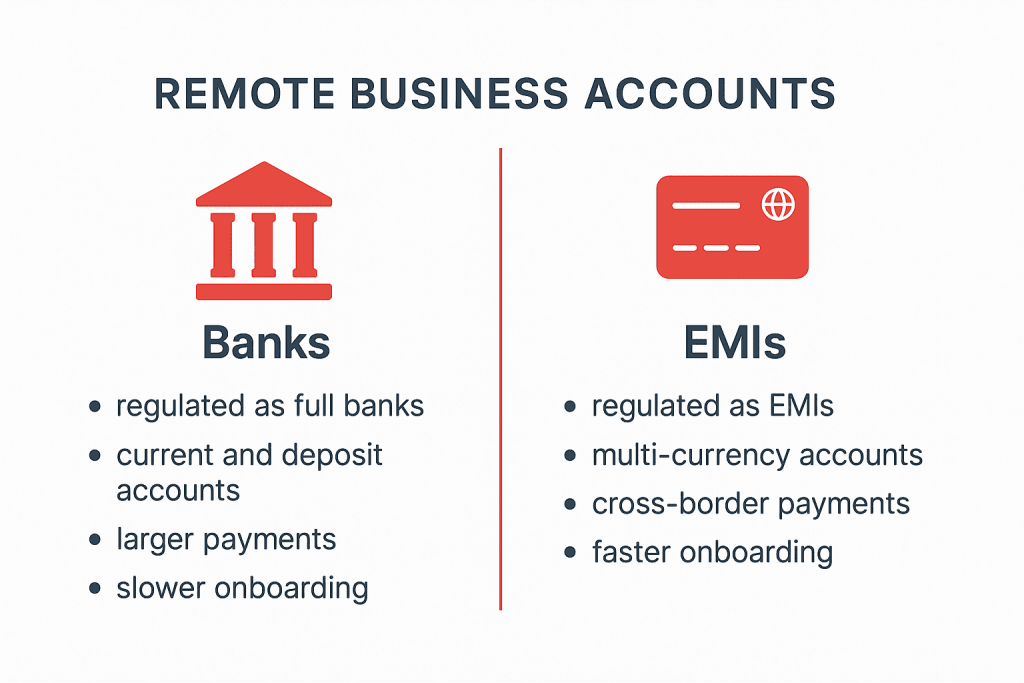
- Regulation: Operate under full prudential banking regulations with strict capital and liquidity rules.
- Function: Offer current accounts, deposits, and can eventually extend loans or credit lines.
- The Value: Strong for large, strategic settlements and for signalling to the market that your company is well governed and substantial.
- The Trade off: They take longer to onboard and ask granular questions about tax residency, substance, and long term plans.
EMIs (Electronic Money Institutions)
- Regulation: Operate under payment and electronic money rules, focusing on the “safeguarding” of client funds rather than lending.
- Function: Provide multi currency business accounts, corporate cards, and payment gateways.
- The Value: Usually faster, digital first, and highly transparent on Foreign Exchange (FX) and mid sized cross border payments.
- The Trade off: Highly sensitive to risk profiles. They may offboard clients quickly if transaction patterns change unexpectedly or look “high risk.”
The FinPro Strategy: In practice, most international companies thrive on a combination. The Bank provides weight and stability, while the EMI provides speed and flexibility.
Decoding Compliance: What KYC and KYB Teams Actually Want
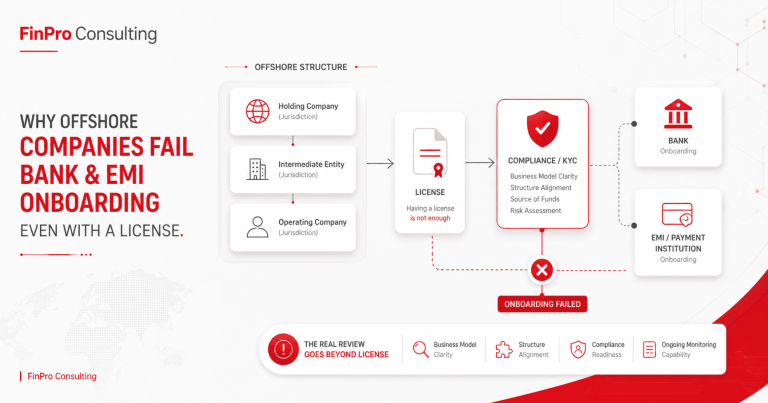
Contrary to popular myth, KYC (Know Your Customer) and KYB (Know Your Business) teams are not trying to block you. They are simply investigators trying to answer three fundamental questions.
If you provide the answers before they have to dig for them, your approval chances rise sharply.
Who is really behind this company?
- A clear ownership chart drilling down to the Natural Person Beneficial Owners (UBOs).
- Identity and proof of address for every owner and director.
- A simple explanation of who controls the funds and who holds signing rights.
Where does the money come from, and where does it go?
- A business model explained in plain English (no jargon).
- Real contracts, invoices, and proof of work/delivery.
- Previous bank statements or financials, if available.
- A simple transaction map showing typical payers, payees, and flow of funds.
Is this business compatible with our risk appetite?
- The location of your clients and suppliers.
- Your industry (is it restricted or sensitive?).
- Screening against sanctions lists, PEPs (Politically Exposed Persons), or negative media.
- Your internal policies on AML and data protection.
The Finance Team Experience: A Comparison
Rather than a technical feature list, it helps to look at how each option feels from an operational perspective.
| Feature | Typical Bank Experience | Typical EMI Experience |
| Best Use Case | Sending/receiving large amounts; Payroll, Rent, Tax payments. | Day to day collections from global clients; Corporate cards; FX. |
| Audit & Perception | Strong positioning when auditors or investors review the structure. | Excellent for operational speed and integration with digital tools. |
| Cost Structure | Fees are reasonable for domestic/SEPA flows, but FX spreads can be average. | Pricing is usually clear and competitive, especially for cross-currency flows. |
| Onboarding | Several weeks to months; often involves a video interview. | Mainly online; can be completed in days if documents are perfect. |
A simple framework we recommend to clients:
- Use a Bank as your Anchor for institutional comfort, profit retention, and critical settlements.
- Use an EMI as your Accelerator for receivables, payables, and currency agility.
- Redundancy: Keep both active so that a compliance freeze in one does not halt your entire business.
The Roadmap: Typical Process and Timeline
While every provider has quirks, the journey generally follows this pattern:
Step 1: Preparation. Collect corporate documents, UBO charts, and the “evidence of business” (contracts/invoices). Crucial: Clean up your website and LinkedIn presence so they match the story you plan to tell.
Step 2: Pre check. A short exchange with an onboarding specialist or RM. Confirm your industry and jurisdiction are within their policy before filling out forms.
Step 3: Formal Submission. Complete the application. Ensure your description of activity is consistent across every answer.
Step 4: Review and Q&A. Expect questions. Do not just write one line replies; answer in detail and attach supporting documents.
Step 5: Approval and Go Live. Sign terms, set mandates, and fund the account. Tip: Test a small transaction in and out before relying on the account for critical payroll or supplier payments.
Strategies That Work: Tailoring Your Approach
Different business models call for different banking stacks.
- Consulting & Tech Services: Start with a modern EMI to receive client payments in various currencies immediately. Once you have 3–6 months of clean history, approach a Bank with that evidence in hand.
- Trading & Ecommerce: Use a Bank for core settlements, customs, and tax. Maintain EMIs for marketplace collections, card acquiring, and FX. Ensure logistics documents match your invoicing.
- Holding Companies & SPVs: Focus first on a solid Bank account (and potentially custody/brokerage accounts). Use EMIs only if moving small operational amounts.
Why Accounts Get Rejected (and How to Fix It)
If you receive a decline, pause and diagnose. Most refusals stem from these issues:
- Ownership is opaque: It looks like you are hiding the UBO.
- Source of funds is vague: “Consulting income” is not an explanation; a contract is.
- Risk exposure: You are dealing with high-risk countries without a strong compliance explanation.
- Digital mismatch: Your website, email domain, and public footprint do not match the declared activity.
The Fix: Strengthen your evidence chain. Simplify payment routes (remove unnecessary third party intermediaries). Write a clear internal memo explaining the business in normal language and reuse it for the next application.
How FinPro Can Help
Remote banking and EMI accounts are now standard tools, but the order in which you approach providers and the way you present your business still matter a lot.
If you plan to open a business account, you can send FinPro a brief summary of your company and basic information about shareholders and directors. We will review your structure, sector and target markets and then propose a realistic account opening plan that fits your situation, including which type of provider to approach first and which key documents to prepare before you apply.
Ready to Secure Your Business Account?
Navigating compliance doesn’t have to be a roadblock. Whether you need a traditional bank for stability or an EMI for speed, our team can build the right roadmap for your structure.
Get Your Banking Strategy →