Why Offshore Companies Fail Bank & EMI Onboarding in 2026, Even With a License
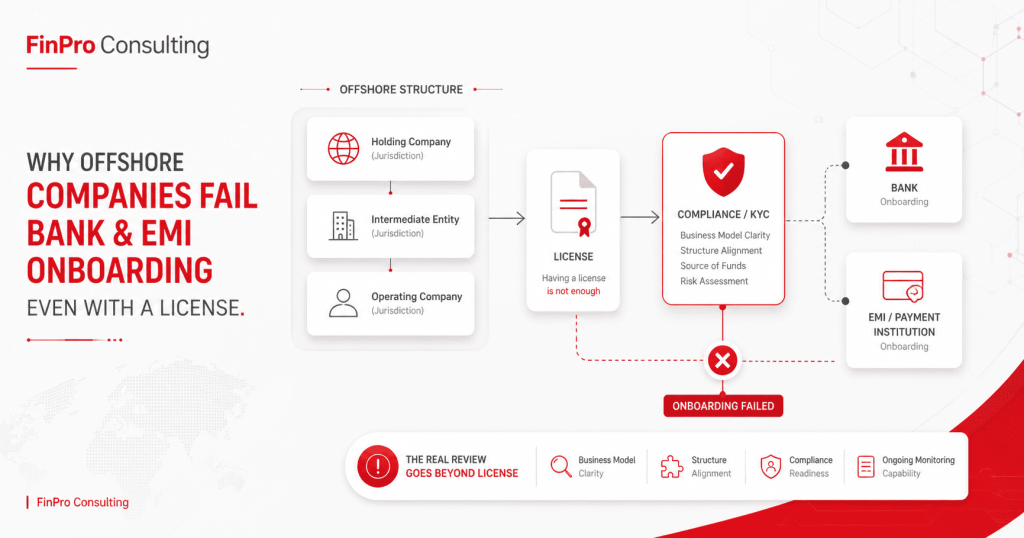
Getting a company registered offshore used to be the hard part. In 2026, it is the easy part.
Founders incorporate in Seychelles, Mauritius, or Saint Lucia. Some pick up a license or a legal opinion along the way. Then they hit the actual wall: the bank says no, the EMI goes quiet, the payment provider keeps asking questions, the platform wants more documents.
Most offshore projects do not die at incorporation. They die at onboarding.
A License Is Not a Bank Account
This is still the most common misconception in offshore financial services.
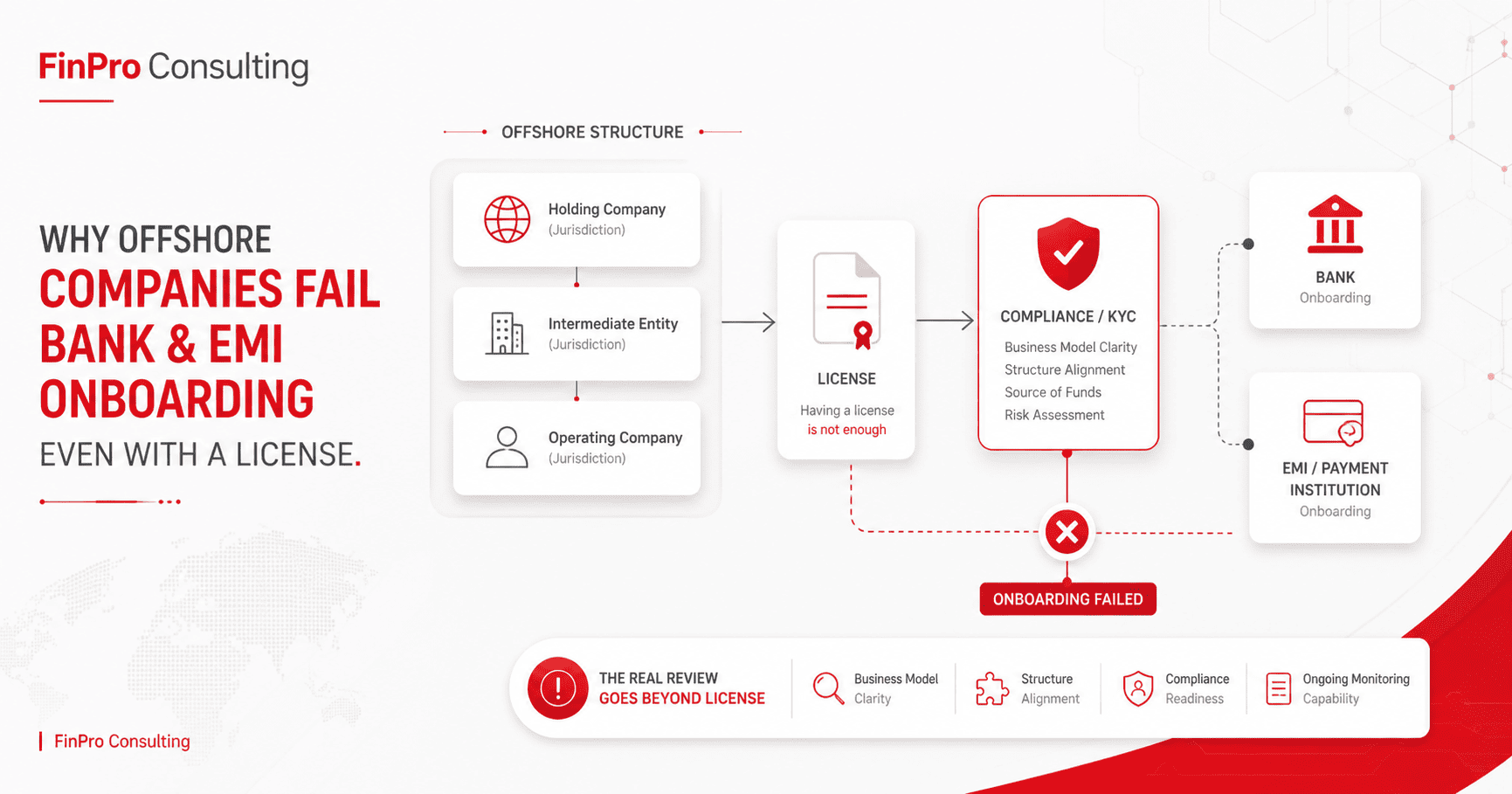
Banks, EMIs, payment providers, liquidity providers, and platform vendors each make their own risk decisions — independently, and with no obligation to honor what a regulator approved. A Seychelles FSA license tells a compliance officer that a regulator was satisfied. It does not tell them what your business actually does, who your clients are, or where the money flows.
The old sequence — register, license, bank, operate — no longer holds. The better question now is: can this structure survive a real onboarding review?
If it cannot, the license will not save it.
What Banks and EMIs Are Actually Evaluating
It comes down to one thing: clarity.
They need to understand who owns the company, where the capital came from, what the business does, who the clients are, which countries they come from, how deposits and withdrawals work, which entity holds client funds, which entity signs contracts, and which vendors are involved.
If any of these answers are missing, inconsistent, or contradicted by another document, the application stalls. Not because the jurisdiction is wrong. Because the story does not hold together.
A bankable structure is not the most legally sophisticated one. It is the one that can be explained on a single page.
What Each Jurisdiction Actually Offers
Seychelles is fast, familiar, and widely used. But a Seychelles entity almost always depends on external banking or EMI arrangements — it does not come with built-in financial infrastructure. The license may be real, but the bank reviewing your account application will still apply its own criteria. Seychelles is a useful starting point. It is not a complete solution.
Mauritius generally carries stronger institutional credibility. For businesses dealing with counterparties that care about regulatory standing, this matters. But Mauritius also demands more: genuine substance, governance, compliance controls, local presence. It is a stronger option — not a faster one.
Saint Lucia is often used for efficient company formation or as one layer in a broader structure. The key misunderstanding: incorporation there does not mean the company is licensed to conduct regulated financial services. Saint Lucia can play a useful role in the right architecture. It cannot replace licensing, banking preparation, or platform approval.
Why Most Structures Fail
Rarely is there a single cause. More often, the full story simply does not hold together.
The license and the actual business do not match. The documents say consulting or technology. The website looks like a brokerage. Banks notice this immediately.
AML and KYC documents are templates. Generic compliance policies are easy to spot. Banks want to see controls that actually reflect your client base, your transaction flow, and your specific risk exposure — not a document that could have come from anyone.
The structure is too complex to explain. Multiple entities across multiple jurisdictions is not inherently a problem. But if no one can articulate why each entity exists and how the money moves between them, the structure looks like evasion rather than planning.
The money flow cannot be shown clearly. Where does money enter? Where does it go? Who collects from clients? Who pays vendors? Is client money segregated? If this cannot be mapped on a single diagram, the structure is not ready for banking.
The documents contradict each other. The business plan says one thing. The website says another. The license scope says something narrower. The EMI application uses different language. For compliance teams, inconsistency is not a minor issue — it is a red flag.
Banking Is Not the Only Gate
For brokers and fintech operators, onboarding is a chain — not a single door.
Beyond banking and EMI approval, a company may also need to pass reviews from trading platform providers, liquidity providers, payment processors, CRM vendors, KYC technology partners, and other operating counterparties. MetaQuotes, for example, applies its own approval process to white label and grey label applicants — evaluating corporate structure, jurisdiction, ownership transparency, and website compliance independently of any regulator.
A structure can pass one gate and fail the next. A weak foundation creates cumulative risk across all of them.
What a Stronger Structure Looks Like
The strongest offshore structures are rarely the most sophisticated. They are the most legible.
A structure that holds up across onboarding reviews typically has: clear ownership with transparent UBO documentation, a corporate hierarchy that can be explained simply, a logical reason for each jurisdiction chosen, a business model that matches the license scope, defined client regions and transaction flows documented in advance, AML/KYC policies written for the actual business rather than copied from a template, and website content that is consistent with every other document submitted.
The goal is not to impress. The goal is to be understood.
The Real Standard in 2026
Offshore success is no longer measured by how fast you can register or how cheaply you can license. Registration and licensing are entry points. The real test is whether the structure can survive what comes after: bank onboarding, EMI review, payment provider approval, platform due diligence, liquidity provider checks, and ongoing compliance.
A financial structure designed only for registration will not survive operation.
FinPro Consulting works with financial services founders, brokers, and fintech operators on offshore and midshore structuring — covering company formation, licensing coordination, bank and EMI onboarding preparation, AML/KYC documentation, website and business positioning review, and platform onboarding support.