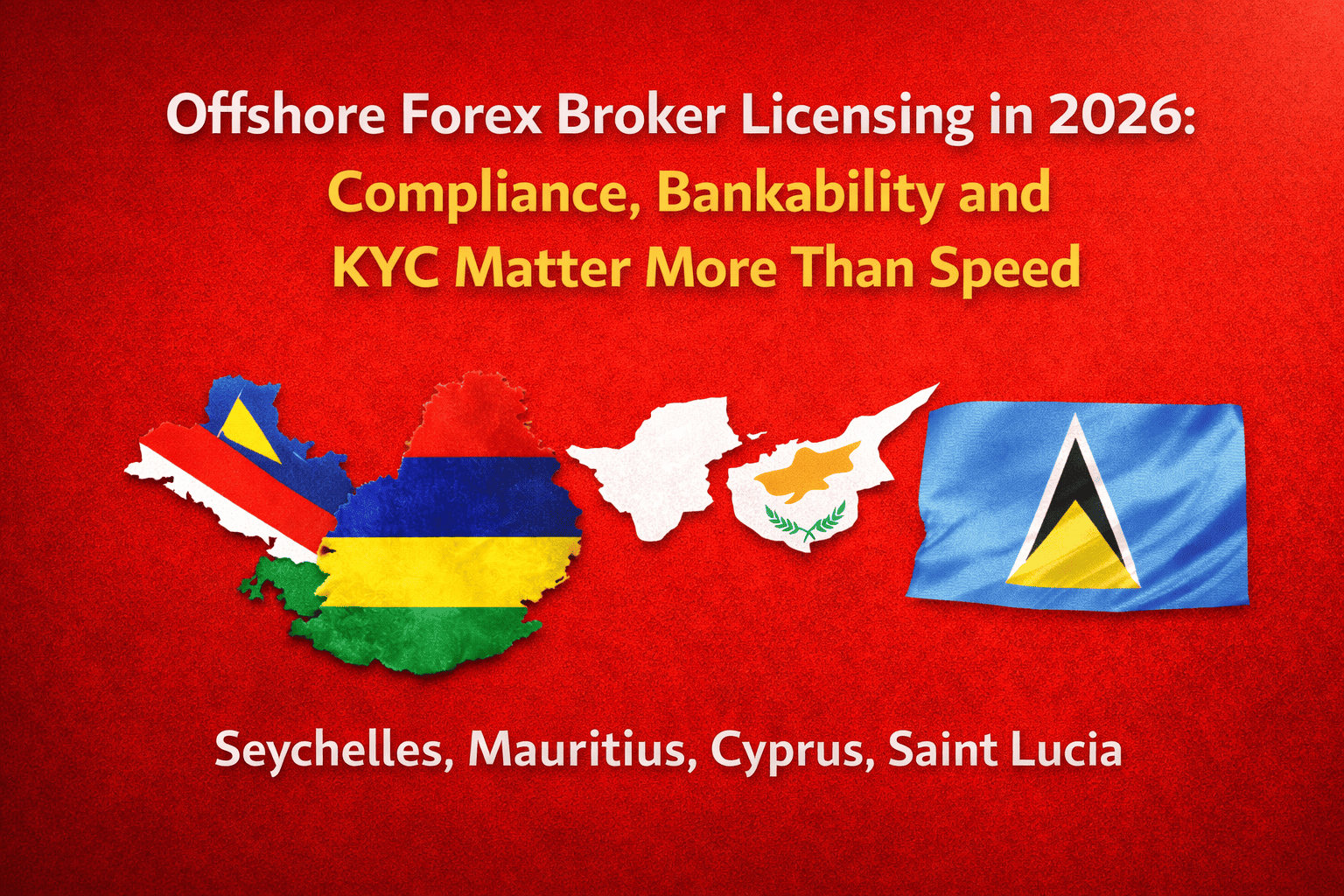
Offshore Forex Broker Licensing in 2026: Why Compliance, Bankability and KYC Matter More Than Speed

For years, many founders approached offshore broker licensing with a simple question: which jurisdiction is the fastest and most cost efficient? In 2026, that question is no longer enough. The more important issue is whether the structure is defensible to regulators, acceptable to banks and EMIs, and sustainable under ongoing AML and KYC scrutiny.
Recent developments across offshore and midshore jurisdictions point in the same direction: licensing is becoming more compliance intensive, not less. Regulators increasingly want to see beneficial ownership transparency, reporting discipline, product risk assessment, valid due diligence files and operational readiness before an application can be considered robust.
That shift matters because the license is no longer the end goal. It is one part of a larger chain that includes regulatory approval, bank or EMI onboarding, payment processing, compliance monitoring and long term operating stability.
Seychelles: still viable, but the compliance burden is getting sharper
Seychelles remains a well known jurisdiction for offshore broker structures, but founders should no longer evaluate it through the lens of speed alone. The regulatory direction is clear: stronger attention is being given to beneficial ownership, updated securities frameworks, virtual asset transition expectations and risk assessment for new products or technologies.
In practical terms, that means a stronger Seychelles application now depends on clean ownership mapping, clear source of funds narratives, a real AML and KYC framework, and a credible explanation of the business model. A broker planning to offer more complex products, higher risk geographies, introducing broker structures or digital asset linked services will need a more carefully prepared compliance file than in earlier market cycles.
Seychelles can still be an effective choice, but it works best for applicants who are prepared to treat regulatory compliance as an operating requirement rather than a box ticking exercise.
Mauritius: faster for some applicants, but only if the regulator already knows you
Mauritius is taking a different path. It has been positioning itself as a more credibility driven financial centre, and that matters for founders who are thinking beyond initial setup. The FSC’s Known to the Commission framework is a useful example. It can make parts of the approval process more efficient for certain applicants already known to the regulator, but it does not remove AML, KYC or fitness and propriety expectations.
This distinction is important. Acceleration does not mean relaxation. Mauritius is not offering a shortcut around documentation, due diligence or governance. It is offering a more efficient route where the regulator already has a verified basis for trust and where the applicant’s records remain current and defensible.
For brokerage founders, Mauritius may be particularly attractive where the long term objective includes stronger institutional credibility, cleaner banking dialogue and a more structured supervisory environment.
Cyprus and the EU: the benchmark effect is getting stronger
Even if a founder does not intend to launch directly in the EU, EU regulatory developments increasingly shape expectations elsewhere. In February 2026, CySEC issued Circular C757, requiring Cyprus Investment Firms to report cross border data for EEA host states where they provided services to more than 50 retail clients during 2025. The circular sets out detailed reporting expectations tied to cross border service provision under MiFID.
At the same time, AMLA opened a public consultation on draft RTS on Customer Due Diligence on 9 February 2026, with a deadline of 8 May 2026. AMLA states that the purpose is to specify in more detail how CDD requirements under the new EU AML regime should be applied, including the information and documents to be collected.
Why does this matter for an offshore licensing strategy? Because banks, EMIs, payment partners and compliance vendors increasingly look at offshore firms through the lens of higher standard jurisdictions. When EU supervisory expectations become more granular around customer due diligence, documentation and cross border servicing, those standards tend to influence onboarding expectations well beyond the EU itself. That is partly an inference, but it is a commercially important one for any founder planning a brokerage, payments or crypto related structure.
Where Saint Lucia fits in 2026
Saint Lucia remains relevant in many cross border structuring discussions, but the currently visible public materials from the Financial Intelligence Authority are centered on beneficial ownership identification and verification, customer due diligence measures, politically exposed persons, risk based assessment, and suspicious activity reporting. In other words, the public emphasis is on AML/CFT fundamentals rather than on a visible 2026 licensing fast track.
That means Saint Lucia can still be useful in the right circumstances, but the structure must align with the actual business model, target market, counterparties and onboarding strategy.
Bank and EMI onboarding: this is where many offshore structures now succeed or fail
One of the biggest mistakes made by startup brokers is to treat licensing and bank onboarding as separate workstreams. They are no longer separate in any meaningful operational sense.
The UK FCA’s payment safeguarding reforms are a useful reference point. The FCA said in August 2025 that new safeguarding rules for payment and e-money firms will require annual audits, monthly reporting, daily checks to ensure the correct amount of customer money is safeguarded, and better failure planning, and it states that the rules will come into effect on 7 May 2026. The FCA also explained that it found weaknesses in existing safeguarding practices and wants stronger protection for consumers and market integrity.
Even though these are UK payment sector rules rather than offshore broker licensing rules, the commercial message is obvious: onboarding institutions are operating in an environment where regulators expect better recordkeeping, tighter control of customer funds, clearer governance and stronger operational documentation. As a result, brokers seeking bank accounts, EMI accounts or payment processing relationships should expect more detailed KYB requests, deeper questioning around ownership and source of funds, and more scrutiny of transaction flows, counterparties and target markets. That conclusion is an inference, but it follows naturally from the direction of the published rules.
What founders should prepare before filing any offshore broker application
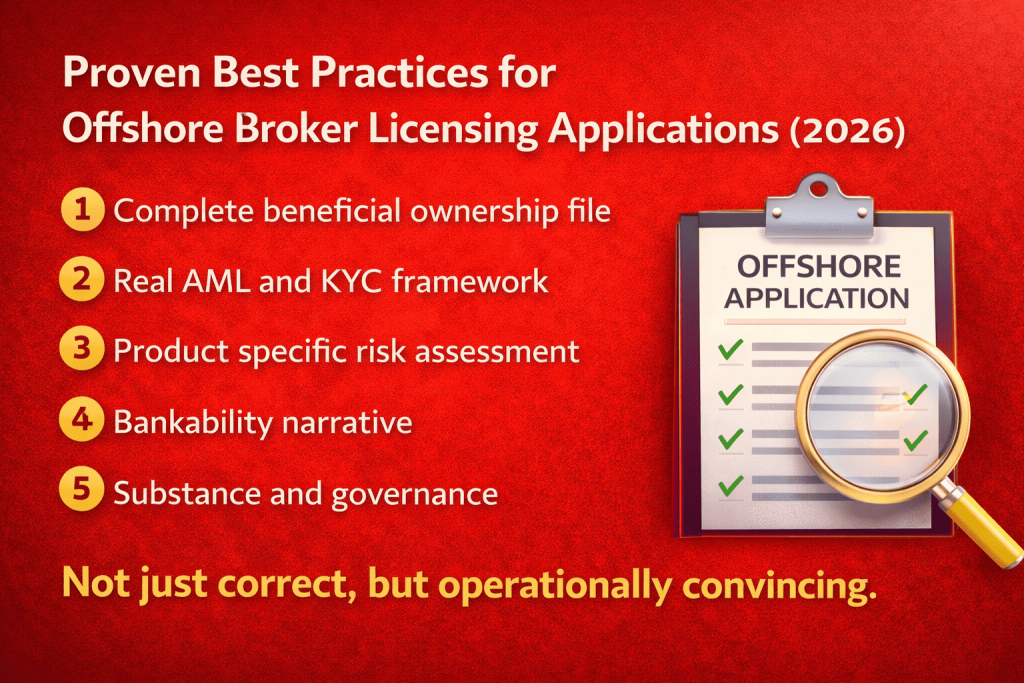
In this environment, the strongest applications are not just legally correct. They are operationally convincing. A practical founder checklist in 2026 should include:
1. A complete beneficial ownership file
This should include the group chart, UBO logic, control rights, shareholder explanation, source of funds background and documentary support. Weak ownership files remain one of the fastest ways to delay both licensing and onboarding.
2. A real AML and KYC framework
Not a template pulled from a generic provider, but a framework that actually matches the business model, target markets, payment flows, customer types and product risk profile.
3. Product specific risk assessment
This is especially important where the model involves virtual asset exposure, higher risk jurisdictions, introducing brokers, white label relationships, cross border payments, or technology enabled onboarding. Seychelles’ 2026 circular on ML/TF risks for new products and technologies is a reminder that regulators increasingly expect this work to be done before launch, not after.
4. A bankability narrative
Applicants should be able to explain, in plain terms, how money flows through the business, which counterparties are involved, what safeguarding or segregation logic applies, where settlement happens, and how suspicious activity would be identified and escalated.
5. Substance and governance
A jurisdiction choice is more credible where the governance structure, compliance function, outsourcing model and recordkeeping arrangements are all coherent. Mauritius’ KTC framework, for example, still requires valid CDD records, recent screening and confirmation by directors and compliance officers.
Seychelles vs Mauritius: how to think about the choice in 2026
Choose Seychelles if the priority is an offshore structure with a regulator that is still active in the space, but be prepared for growing emphasis on beneficial ownership review, VASP transition expectations, product risk assessment and updated securities framework requirements.
Choose Mauritius if the priority is a more credibility driven route with stronger regulatory positioning and better long term alignment for applicants who care about bankability, institutional perception and cleaner supervisory dialogue. But do not mistake procedural efficiency for weaker compliance. The FSC’s own KTC framework shows the opposite.
Use Cyprus as the benchmark jurisdiction when the commercial plan includes EU market logic, more sophisticated counterparties, or future scaling that may require alignment with MiFID style reporting and EU AML expectations.
Assess Saint Lucia carefully and case by case where the objective is not simply “speed,” but a structure that can actually survive due diligence from service providers and counterparties. Current public guidance underscores beneficial ownership, CDD and risk based AML discipline.
FinPro Consulting: Your Compliance and Tech Migration Engine
The offshore market in 2026 is not becoming impossible. It is becoming more selective.
The jurisdictions that still work are the ones where founders arrive prepared with a coherent ownership story, a credible AML and KYC framework, a defensible business model and a realistic onboarding strategy. The firms that struggle are usually the ones that treat the license as the end goal, rather than as one part of a larger chain that includes regulatory approval, banking, payments, operations and ongoing compliance.
That is the real shift in 2026. The winning offshore structure is no longer the one that is simply fastest to incorporate. It is the one that is most likely to remain licenced, banked and operational twelve months later. The recent regulatory signals from Seychelles, Mauritius, Cyprus, the EU AMLA process, the UK safeguarding regime and Saint Lucia’s AML guidance all point in that direction.
Need help choosing between Seychelles, Mauritius, Cyprus or Saint Lucia for your broker, fintech or investment structure? FinPro Consulting supports clients with jurisdiction analysis, licensing strategy, AML/KYC documentation, corporate structuring, and bank or EMI onboarding preparation.
Frequently Asked Questions
Is Seychelles still a good jurisdiction for offshore broker licensing in 2026?
Yes, but it should no longer be viewed as a purely speed driven option. Recent FSA circulars show stronger attention to securities law updates, beneficial ownership review, VASP transition requirements and ML/TF risk assessments for new products and technologies.
Does the Mauritius FSC KTC framework mean easier licensing?
Not exactly. It means faster processing for certain applicants already known to the Commission, provided they are in good standing and their due diligence records remain current. The FSC still reserves discretion to request updated documents and clarifications.
Will having a license guarantee a bank or EMI account?
No. A license helps, but onboarding institutions will still assess ownership, source of funds, compliance controls, business model risk and operational readiness. The wider regulatory trend is toward stronger documentation and customer fund protection, not lighter review.
Why does Cyprus matter even for non-EU offshore structures?
Because EU reporting and AML standards increasingly influence how banks, EMIs and compliance partners evaluate firms globally. CySEC’s 2026 cross border reporting exercise and AMLA’s detailed CDD consultation are part of that benchmark effect.