Singapore MAS updates payment-services licensing guidance: What FinTechs and EMIs must adjust now

On 8 October 2025, the Monetary Authority of Singapore (MAS) refreshed its Guidelines on Licensing for Payment Service Providers under the Payment Services Act (PSA). The update tightens clarity around licence scopes, fees, and supervisory expectations for both Standard Payment Institutions (SPI) and Major Payment Institutions (MPI), and reiterates AML/CFT obligations aligned with MAS Notices.
What changed—at a glance
- PS-G01 refreshed. MAS updated the Guidelines on Licensing for Payment Service Providers (PS-G01), clarifying what goes into an application and ongoing expectations, including fees referencing the Payment Services Regulations (PSR) Schedule.
- SPI/MPI framing reaffirmed. The guideline cross-references licence classes and thresholds under the PSA; MAS’ licensing pages continue to define SPI vs MPI scope and volume triggers.
- AML/CFT emphasis. Expect clear mapping to Notice PSN01 (non-DPT services) and PSN02 (DPT services), plus the latest guideline aids.
- Technology risk + third-party risk. MAS’ TRM Guidelines and TRM Notices under the FSMA remain anchor references; outsourcing expectations for non-banks (which include most payment institutions) now sit in the Guidelines on Outsourcing (Financial Institutions other than Banks) (effective 11 Dec 2024). Maintain an up-to-date outsourcing register.
- Ongoing requirements signposted. Safeguarding, reporting, and other continuing obligations stay central for licencees.
Who is affected?
- Prospective SPI/MPI applicants (including cross-border wallets, merchant acquirers, remitters, stored-value/e-money issuers, and DPT players adding fiat rails).
- Existing licensees renewing, expanding service scopes, or adjusting volumes (e.g., adding DPT under an existing SPI/MPI).
- Regional groups using Singapore for treasury, settlement, or card acquiring hubs—because safeguarding, outsourcing, and AML/CFT controls are now scrutinised across affiliates and vendors.
Founder/COO checklist (practical and actionable)
1) Governance & people
- Refresh board and senior-management accountability statements for PSA services in-scope.
- Re-confirm fit-and-proper declarations; align compliance reporting lines and escalation.
2) Business model & licensing scope
- Map every product flow to PSA service categories (e.g., account issuance, domestic/cross-border transfer, merchant acquisition, e-money issuance, DPT).
- Validate licence class (SPI vs MPI) against projected volumes; document assumptions.
3) Safeguarding of customer monies
- Re-evidence trust/guarantee arrangements, reconciliation cadence, designated accounts, and disclosures.
- Test failure scenarios (insolvency, payout timelines).
4) AML/CFT programme
- Trace policy sections to PSN01/PSN02 paragraphs; refresh CDD/KYC, sanctions, EDD for higher-risk corridors, agent oversight, and STR reporting.
- Ensure training logs and effectiveness reviews are current.
5) Technology & third-party risk
- Evidence TRM controls: access management, change management, logging/monitoring, BCP/DR, incident reporting.
- Maintain an outsourcing register (who/what/where/SLAs), risk assessments, and exit plans.
6) Application dossier hygiene (for applicants / variations)
- Align with PS-G01 content requirements; include up-to-date Form 1 data points, organisational charts, financials, and where required, legal opinions/independent assessments (esp. for DPT).
7) Fees & declarations
- Reconfirm the applicable application/annual fees under the PSR Schedule; keep board attestations and declarations in sync with the refreshed guideline text.
Key facts & references you should cite in your internal memo
- PS-G01—sets expectations for eligibility, application composition, and supervisory touchpoints.
- SPI/MPI classes & service taxonomy—seven PSA services and licence-class thresholds guide your path to market.
- Fees—application and annual fees anchored in PSR Schedule; Form 1 highlights payment and information requirements.
- AML/CFT—PSN01/PSN02 and corresponding guidelines remain the standard for programme design and monitoring.
- TRM & Outsourcing—apply MAS TRM Guidelines/TRM Notices and non-bank Outsourcing Guidelines; keep an auditable outsourcing register.
Common pitfalls (and how to pre-empt them)
- Under-scoped AML/CFT: Insufficient corridor risk analysis, weak agent oversight, or outdated sanctions screening will slow approvals or trigger remediation. Map controls directly to PSN01/02 clauses.
- Safeguarding gaps: Missing trust account confirmations, reconciliation breaks, or unclear customer disclosures threaten ongoing compliance.
- Outsourcing opacity: If your engineering or operations rely on vendors (cloud, KYC, payouts), MAS expects risk assessments and an accurate register.
Your 30-day action plan
- Gap-analysis vs PS-G01: Assign owners across Legal, Compliance, Finance, Tech, Ops.
- Refresh policies/procedures: Update AML/CFT, safeguarding, incident response, and vendor-risk SOPs to current notices/guidelines.
- Confirm safeguarding & outsourcing registers: Reconcile balances and test payout procedures; update vendor inventory.
- Prep board materials: Summarise deltas, residual risks, and required attestations for sign-off.
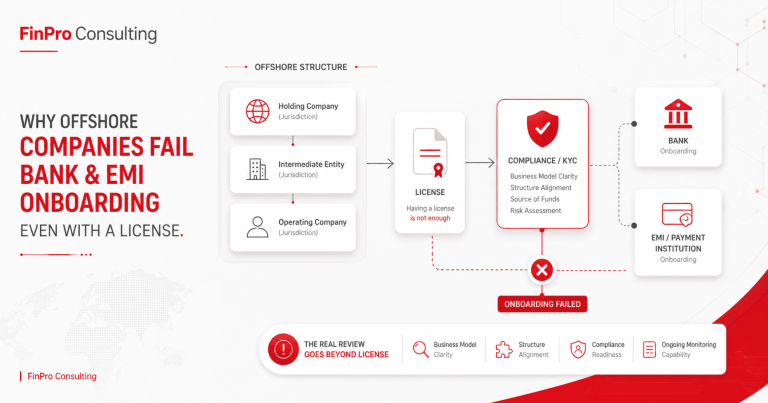
- Re-engage banks/partners: Share updated controls pack (governance, AML/CFT, TRM, safeguarding) to keep onboarding smooth.
How FinPro Consulting can help
- Licence & scope advisory (SPI/MPI): Choosing the right path, mapping services to PSA, preparing Form 1 & annexes.
- Policy stack & controls: AML/CFT (PSN01/02), safeguarding, TRM, outsourcing registers, incident playbooks.
- Bank/EMI partner readiness: Packaging compliance evidence to accelerate onboarding.
- Build-out support: Company setup, website & domain, and payments/EMI banking introductions via our regional network.
👉 Book a consult: Financial Licensing · Payment/EMI Accounts · Bank Account Opening · Company Formation