Why “No KYC” Crypto Card Models Are Failing and What That Means for FinTech Compliance in 2026
For the last two years, “no KYC crypto card” has been one of those phrases that spreads faster than the products behind it. The pitch is simple: spend crypto like cash, globally, without identity checks. The reality is less glamorous. If a card works on mainstream rails, it sits inside a chain of regulated counterparties (issuer, program manager, BIN sponsor, network, processor, acquirer). And that chain does not tolerate anonymous end users for long.
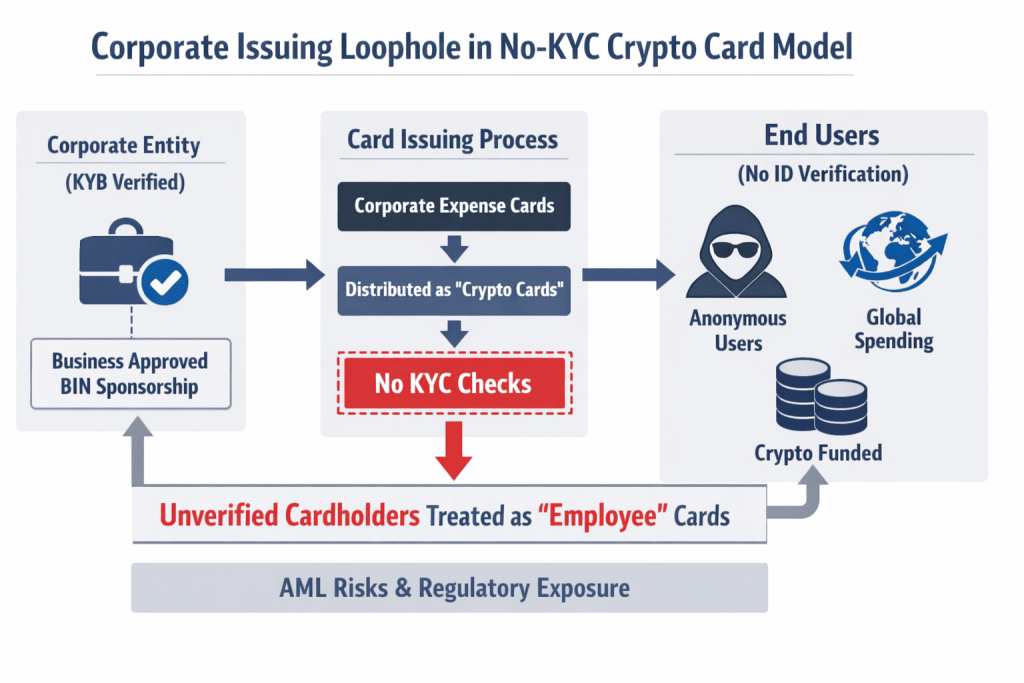
What we are watching now is not just a few isolated shutdowns. It is a structural unwind of a business model built on a corporate issuing loophole: complete KYB once at the company level, then distribute “employee” cards at scale without verifying the individuals holding them. Once scrutiny arrives, the outcome is predictable: partner banks de risk, BINs get pulled, and the card program stops overnight.
The uncomfortable truth about “no KYC” cards: someone else is taking the regulatory risk
A consumer facing brand can claim “no KYC” only by pushing identity obligations down the stack and hoping nobody asks questions. But card networks and sponsor banks ultimately own the compliance exposure tied to their BINs and licenses. When they conclude the program is being used to bypass AML expectations, they do not negotiate with marketing copy. They turn it off.
A recent example in February 2026: Payment Expert reported that Mastercard shut down cards linked to UnCash’s “no KYC” service, and the company publicly framed the move as an existential blow to its ability to operate.
This is the core fragility of the model: the most important stakeholder is not the end user, it is the regulated institution whose access you are renting.
How the corporate issuing loophole actually worked
Most people hear “corporate cards” and imagine a CFO issuing expense cards to employees. That is the legitimate use case. The loophole appears when a fintech or program layers a public distribution model on top of a corporate expense framework.
Typical pattern:
- A corporate entity passes KYB with a program manager / issuer sponsor to access card issuing under a BIN.
- Cards are issued as “business” or “employee” spend cards under that corporate umbrella.
- The product is marketed to the public (or to loosely defined “members”) as a crypto funded debit card.
- End users are not properly identified because they are treated as “cardholders under the corporate client,” not retail customers.
- Volume, geography, and behavior drift toward exactly what AML teams flag: cross border usage, cash like spend, high velocity, and hard to attribute beneficial ownership.
Fintech Business Weekly described this dynamic directly in reporting about “no KYC” crypto cards tapping corporate issuing structures, and noted that after inquiries in early October 2025, BINs associated with Paywithus appeared to be shut down.
Once you view the model through this lens, the failure mode is obvious: the more successful the distribution becomes, the more it resembles anonymous retail issuance running through a corporate wrapper. That is not a compliance grey area; it is a red flag.
Why enforcement is accelerating in 2026: networks and banks are tightening the chain
Regulators have been moving toward clearer accountability across payment chains, and banks are translating that into stricter program oversight. FATF’s June 2025 update on Recommendation 16 (payment transparency) explicitly emphasizes clarifying responsibilities in the payment chain and standardizing required originator information for certain cross border payments.
Separately, Travel Rule implementation keeps expanding globally. FATF’s Travel Rule supervision best practices note that survey results show many jurisdictions have implemented or are implementing the Travel Rule, with regional momentum in Europe linked to frameworks like MiCAR and the revised Transfer of Funds regulation.
Even where the Travel Rule is not “about cards” in a narrow sense, the direction is consistent: more attribution, more traceability, less tolerance for identity gaps in any value transfer product that touches regulated rails.
On onboarding expectations, supervisors are also getting more explicit on what “good” looks like in remote identity and customer due diligence. The EBA’s guidelines on remote customer onboarding set out risk sensitive expectations for institutions onboarding customers non face to face, reinforcing that digital onboarding must still meet AML standards.
Put those together and you get the 2026 compliance reality:
- If your product enables payments, withdrawals, or cross border movement of value, someone in the chain must be able to reliably identify the user and explain the controls.
- If you cannot, the chain will not carry you.
The real risks: it is not just regulators, it is counterparties
Founders often focus on “will the regulator come after us?” The more immediate risk is usually counterparty enforcement:
1) BIN and program termination risk
If your issuing access depends on a sponsor’s risk appetite, your runway can end in a day. The UnCash case illustrates how quickly a network decision can effectively stop operations.
2) Partner bank de risking
Banks look at second order exposure: downstream distribution, unknown beneficial owners, transaction patterns, and reputational spillover. If they cannot get comfortable, they exit.
3) Frozen funds, user complaints, and chargeback blowups
Shutdowns create operational chaos: pending authorizations, refunds, disputes, and compliance driven holds. Even if you survive legally, you can die commercially.
4) Personal liability and “shadow management” concerns
When a “corporate client” is effectively a wrapper and the real business is public issuance, regulators may treat the structure as intentionally misleading, especially if governance and control reality does not match documentation.
What payment card regulation in 2026 is signaling: compliance cannot be outsourced
Many teams assume they can “borrow” compliance by using a program manager, an issuer processor, or a crypto on ramp partner. In practice:
- You can delegate tasks. You cannot delegate accountability.
- If your funnel, UX, or distribution strategy is built to avoid end user verification, you are designing a compliance failure into the product.
The market is now pricing that reality correctly. “No KYC” is not a growth hack; it is a termination clause disguised as a feature.
What to do instead: a practical compliance playbook for card linked crypto products
If you are building any card linked product involving digital assets, treat identity and attribution as first class product requirements, not back office chores.
1) Map your model clearly: who is the customer?
Be explicit about whether the end user is:
- the corporate client,
- an employee,
- a contractor,
- or a retail customer.
If the end user behaves like a retail customer, build retail grade controls. “Employee” labels will not save you in a review.
2) Close the corporate issuing loophole in your own program rules
If you issue corporate cards, implement controls that make abuse difficult:
- enforce real employer employee relationship evidence,
- restrict issuance volumes per entity until enhanced review,
- require beneficial owner and control person clarity,
- require named cardholder identification for issued cards above defined thresholds.
3) Build layered KYC, not checkbox KYC
A robust AML KYC framework for a card program typically includes:
- customer identification and verification (including liveness where appropriate),
- sanctions and PEP screening,
- source of funds and source of wealth logic for higher risk tiers,
- ongoing monitoring and periodic refresh,
- velocity and anomaly controls tailored to card usage.
4) Treat your partners like supervisors, not vendors
Sponsor banks and networks will ask for:
- your written AML policy,
- your risk assessment,
- transaction monitoring scenarios,
- SAR escalation workflows,
- audit trails,
- and evidence that your controls work in practice.
If you cannot produce these cleanly, you are not “early stage.” You are unbankable.
5) Proactively engage regulators and get ahead of the narrative
Where possible, use:
- regulatory consultations,
- licensing scoping,
- and compliance gap assessments
to align your model early. Waiting until a partner flags you is usually too late.
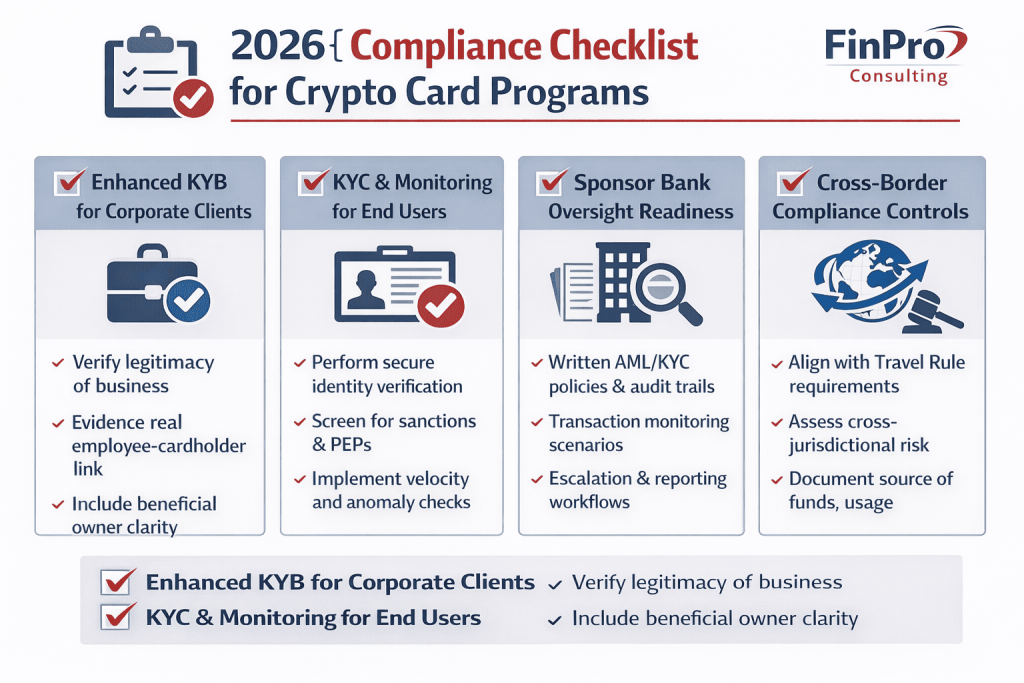
A quick due diligence checklist before you launch any “crypto card” product
If you want a card program that lasts into 2026 and beyond, you should be able to answer these questions in writing:
- Who owns the BIN, and what are the network program rules that apply?
- Who is responsible for KYC, KYB, screening, monitoring, and reporting?
- What exactly is the customer journey for identity verification, and where can it be bypassed?
- What is your policy for corporate issued cards and individual cardholder identification?
- What are your trigger points for enhanced due diligence?
- How do you handle cross border usage, high risk jurisdictions, and cash access?
- If the issuer asks for a portfolio level review tomorrow, can you pass it?
If any of those answers are vague, your risk is not theoretical.
Where FinPro Consulting fits
FinPro Consulting helps fintechs structure compliant payments and digital asset products without relying on fragile shortcuts. That includes:
- program and licensing scoping (cards, e money, VASP alignment where relevant),
- AML KYC framework design and documentation,
- partner readiness (issuer sponsor and program manager due diligence packs),
- KYB and corporate card governance design to prevent downstream misuse,
- and end to end compliance operating models that scale.
If your roadmap involves cards plus crypto, assume scrutiny will increase, not decrease, through 2026. Design for survivability first. Growth follows.